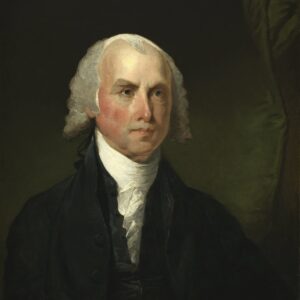

James Madison, a former Delegate to the Constitutional Convention from the Commonwealth of Virginia, using the pseudonym “Publius,” publishes “Federalist #55,” refuting the argument that the House of Representatives will require the “ambitious sacrifice of the many to the aggrandizement of the few,” as Congress will be subject to the statutes it writes for the rest of the Union. In paragraphs two, three, four, six, seven, and eight he writes,
… Who are to be the electors of the federal representatives? Not the rich, more than the poor; not the learned, more than the ignorant; not the haughty heirs of distinguished names, more than the humble sons of obscurity and unpropitious fortune. The electors are to be the great body of the people of the [u]nited States. They are to be the same who exercise the right in every State of electing the corresponding branch of the legislature of the State. Who are to be the objects of popular choice? Every citizen whose merit may recommend him to the esteem and confidence of his country. No qualification of wealth, of birth, of religious faith, or of civil profession is permitted to fetter the judgement or disappoint the inclination of the people. …
… [I]n the situation of the House of Representatives, restraining them from oppressive measures, that they can make no law which will not have its full operation on themselves and their friends, as well as on the great mass of the society. …
If it be asked, what is to restrain the House of Representatives from making legal discriminations in favor of themselves and a particular class of the society? I answer: the genius of the whole system; the nature of just and constitutional laws; and above all, the vigilant and manly spirit which actuates the people of America, a spirit which nourishes freedom, and in return is nourished by it. If this spirit shall ever be so far debased as to tolerate a law not obligatory on the legislature, as well as on the people, the people will be prepared to tolerate any thing but liberty.
[R]epresentation in the British House of Commons very little exceeds the proportion of one for every thirty thousand inhabitants.
The city of Philadelphia is supposed to contain between fifty and sixty thousand souls. It will therefore form nearly two districts for the choice of federal representatives.
One branch of the legislature of Connecticut is so constituted that each member of it is elected by the whole State. So is the governor of that State, of Massachusetts, and of this State, and the president of New Hampshire. I leave every man to decide whether the result of any one of these experiments can be said to countenance a suspicion, that a diffusive mode of choosing representatives of the people tends to elevate traitors and to undermine the public liberty.
[updated 7/25/2026]
Subsequent Events:
Authority:
Articles of Confederation, Article XIII
ccc-2point0.com/Articles-of-Confederation
References:
Federalist No 57 – The Avalon Project
avalon.law.yale.edu/18th_century/fed57.asp
Federalist No. 57 – Wikipedia
en.wikipedia.org/wiki/Federalist_No._57