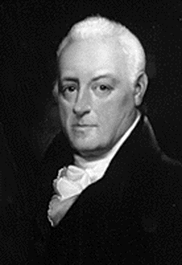
Robert Yates(?), a non-signing Delegate to the Constitutional Convention from New York, using the penname “Brutus,” publishes an anti-federalist essay, warning that ratification of the Constitution for the united States will result in judicial despotism. In paragraph four he writes,
… Rendering the judges independent; which, in the British constitution, means no more than that they hold their places during good behaviour, and have fixed salaries, they have made the judges independent, in the fullest sense of the word. There is no power above them, to controul any of their decisions. There is no authority that can remove them, and they cannot be controuled by the laws of the legislature. In short, they are independent of the people, of the legislature, and of every power under heaven. Men placed in this situation will generally soon feel themselves independent of heaven itself. … [emphasis added]
NOTE: Although the identity of “Brutus” is not known for sure, many scholars believe him to have been Robert Yates, an Associate Justice of the New York Supreme Court.
[restored 10/4/2021]
An anonymous writer publishes “‘A Freeman’ to the Freeholders and Freemen of Rhode Island,” contrasting the unwritten British Constitution against the proposed American Constitution:
|
British Constitution |
American Constitution |
|
|
Powers of the legislature |
Parliament is absolute and may even abolish the Magna Carta. |
Congress’ powers are limited by the Constitution. |
|
Powers of the executive |
The king’s powers are absolute; “the king can do no wrong.” |
The president may be removed from office for wrongdoing. |
|
Foreign policy |
The king has absolute power to appoint ambassadors and to declare war. |
The Senate has the power to block presidential appointments. Congress has the sole power to declare war. |
|
Religion |
The king is the head of the state church. |
The federal government is prohibited from establishing religious qualifications. |
|
Legislative sessions |
The king has the power to convene and dismiss Parliament. |
The president cannot dismiss Congress. |
|
Upper legislative house |
The king has appointment power for the House of Lords. |
The Senate is elected by the State legislatures. |
|
Lower legislative house |
The House of Commons is elected for seven-year terms. |
The House of Representatives is elected for two-year terms. |
[added 7/31/2026]
Subsequent Events:
Authority:
Articles of Confederation, Article XIII
ccc-2point0.com/Articles-of-Confederation
References:
“‘A Freeman’ to the Freeholders and Freemen of Rhode Island,” from The Debate on the Constitution, two volumes, Bernard Bailyn, ed., (New York: Library of America, 1992), 2:368-71.
Murray Dry, The Anti-Federalist: An abridgement, from The Complete Anti-Federalist by Herbert J. Storing, ed., (Chicago and London: University of Chicago Press, 1985), 182-83.
Brutus XV (pt. 1)
www.infoplease.com/primary-sources/government/anti-federalist-papers/brutus-xv-pt-1
The Prophetic Antifederalists | Mises Institute
mises.org/library/prophetic-antifederalists