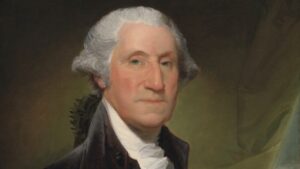
Former President George Washington, of the Constitutional Convention, writes to Gilbert du Motier, Marquis de Lafayette, expressing his satisfaction in the drafting of the Constitution for the united States:
As to my sentiments with respect to the merits of the new Constitution, I will disclose them without reserve … for, in truth, I have nothing to conceal on that subject. … With regard to the two great points (the pivots on which the whole machine must move) my Creed is simply:
- 1st That the general Government is not invested with more Powers than are indispensably necessary to perform [the] functions of a good Government; and, consequently, that no objection ought to be made against the quantity of Power delegated to it.
- 2ly That these Powers … are so distributed among the Legislative, Executive, and Judicial Branches, into which the general Government is arranged, that it can never be in danger of degenerating into a monarchy, an Oligarchy, an Aristocracy, or any other despotic or oppressive form; so long as there shall remain any virtue in the body of the People.
[restored 7/25/2026]
Robert Yates(?), a non-signing delegate to the Constitutional Convention from New York, using the pseudonym “Brutus” begins publishing an anti-federalist essay in which he warns that if the proposed Constitution for the united States is ratified it will destroy the sovereignty of the States, and the federal judiciary will usurp the power of judicial review. In paragraphs 6, 8, 13 and 15 he writes:
[T]he supreme court has the power, in the last resort, to determine all questions that may arise in the course of legal discussion, on the meaning and construction of the constitution.
· · · · · · ·
[T]he judgment of the judicial, on the constitution, will become the rule to guide the legislature in their construction of their powers.
· · · · · · ·
The first object declared to be in view is, “To form a perfect union.” It is to be observed, it is not an union of states or bodies corporate; had this been the case the existence of the state governments, might have been secured. But it is a union of the people of the United States considered as one body, who are to ratify this constitution, if it is adopted. Now to make a union of this kind perfect, it is necessary to abolish all inferior governments, and to give the general one compleat legislative, proposed executive and judicial powers to every purpose. The courts therefore will establish it as a rule in explaining the constitution.
· · · · · · ·
This will certainly give the first clause in that article a construction which I confess I think the most natural and grammatical one, to authorise the Congress to do any thing [sic] which in their judgment will tend to provide for the general welfare, and this amounts to the same thing as general and unlimited powers of legislation in all cases.
NOTE: Although the identity of “Brutus” is not known for sure, many scholars believe him to have been Robert Yates, an Associate Justice of the New York Supreme Court.
[restored 7/25/2026]
Subsequent Events:
Authority:
Articles of Confederation, Article XIII
ccc-2point0.com/Articles-of-Confederation
References:
“George Washinton to Marquis de Lafayette, “Two Basic Reasons to Support the Constitution,” from The Debate on the Constitution, two volumes, Bernard Bailyn, ed., (New York: Library of America, 1992), 2:178-81.
“On the Power of the Supreme Court: Nothing Can Stand Before It,” from The Debate on the Constitution, two volumes, Bernard Bailyn, ed., (New York: Library of America, 1992), 2:171-74.