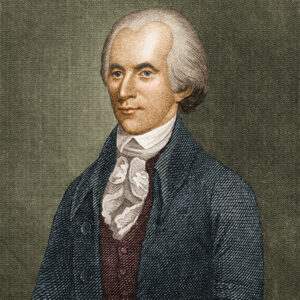
Richard Henry Lee, former President of the united States in Congress assembled, using the pseudonym “The Federal Farmer,” publishes an anti-federalist essay, arguing in paragraph six that the treaty making power in the proposed Constitution for the united States will result in eventual abrogation of the State Constitutions:
The president and two-thirds of the senate will be empowered to make treaties indefinitely, and when these treaties shall be made, they will also abolish all laws and state constitutions incompatible with them. This power in the president and senate is absolute, and the judges will be bound to allow full force to whatever rule, article or thing the president and senate shall establish by treaty. …
[restored 9/26/2021]
Judge George Bryan, of the Supreme Court of the Commonwealth of Pennsylvania, using the pseudonym “An Old Whig” publishes an anti-federalist essay arguing that it will be nearly impossible to amend the proposed Constitution for the united States. In paragraphs one, two, three and four he writes:
… The conventions of the several states cannot propose any alterations-they only to give their assent and ratification. And after the constitution is once ratified, it must remain fixed until two thirds of both the houses of Congress shall deem it necessary to propose amendments; or the legislatures of two thirds of the several states shall make application to Congress for the calling a convention for proposing amendments, which amendments shall not be valid till they are ratified by the legislatures of three fourths of the several states, or by conventions in three fourths thereof as one or the other mode of ratification may be proposed by Congress. -This appears to me to be only a cunning way of saying that no alteration shall ever be made; so that whether it is a good constitution or a bad constitution, it will remain forever unamended. …
… People once possessed of power are always loth to part with it; and we shall never find two thirds of a Congress voting or proposing anything which shall derogate from their own authority and importance, or agreeing to give back to the people any part of those privileges which they have once parted with-so far from it; that the greater occasion there may be for a reformation, the less likelihood will there be of accomplishing it. The greater the abuse of power, the more obstinately is it always persisted in. …
If these reflections are just it becomes us to pause, and reflect previously before we establish system of government which cannot be amended. … It was a celebrated observation of one of our Assemblies before the revolution, during their struggles with the proprietaries, that “those who would give up essential liberty to purchase a little temporary safety deserve neither liberty nor safety.”
For the present I shall conclude with recommending to my countrymen not to be in haste, to consider carefully what we are doing. … And it is certainly suspicious circumstance that some people who are presumed to know most about the new constitution seem bent upon forcing it on their countrymen without giving them time to know what they are doing. [emphasis added]
[restored 7/18/2026]
Subsequent Events:
References:
“An Old Whig [George Bryan] I,” from The Debate on the Constitution, two volumes, Bernard Bailyn, ed., (New York: Library of America, 1992), 1:122-26.
Murray Dry, The Anti-Federalist: An abridgement, from The Complete Anti-Federalist by Herbert J. Storing, ed., (Chicago and London: University of Chicago Press, 1985), 54, 56.
Pamphlets on the Constitution of the United States, published during its Discussion by the People, 1787-1788 – Online Library of Liberty
oll.libertyfund.org/titles/ford-pamphlets-on-the-constitution-of-the-united-states-1787-1788/simple
The Prophetic Antifederalists | Mises Institute
mises.org/library/prophetic-antifederalists