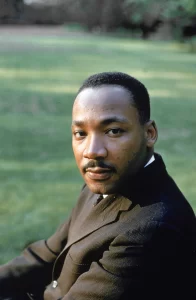
President Martin Luther King, Jr., of the Southern Chrisitan Leadership Conference, speaking at Riverside Church, in New York City expresses his opposition to the Vietnamese-American War:
… I could never again raise my voice against the violence of the oppressed in the ghettos without having first spoken clearly to the greatest purveyor of violence in the world today—my own government. …
· · · · · · ·
They must see Americans as strange liberators. The Vietnamese people proclaimed their own independence in 1945 after a combined French and Japanese occupation, and before the Communist revolution in China. They were led by Ho Chi Minh. Even though they quoted the American Declaration of Independence in their own document of freedom, we refused to recognize them. … They watch as we poison their water, as we kill a million acres of their crops. They must weep as the bulldozers roar through their areas preparing to destroy the precious trees. They wander into the hospitals with at least twenty casualties from American firepower for one Vietcong-inflicted injury. So far we may have killed a million of them, mostly children. They wander into the towns and see thousands of the children, homeless, without clothes, running in packs on the streets like animals. They see the children degraded by our soldiers as they beg for food. They see the children selling their sisters to our soldiers, soliciting for their mothers. … I would encourage all ministers of draft [involuntary servitude] age to give up their ministerial exemptions and seek status as conscientious objectors (pacifists). These are the times for real choices and not false ones. We are at the moment when our lives must be placed on the line if our nation is to survive its own folly. Every man of humane convictions must decide on the protest that best suits his convictions, but we must all protest.
[restored 6/19/2025] Thanks to Jacob Hornberger for this entry.
Subsequent Events:
Authority:
Article I of Amendment
ccc-2point0.com/constitution-for-the-united-states
References:
MLK, “Beyond Vietnam,” 1967
web.mit.edu/21h.102/www/Primary%20source%20collections/Civil%20Rights/Beyond_Vietnam.htm