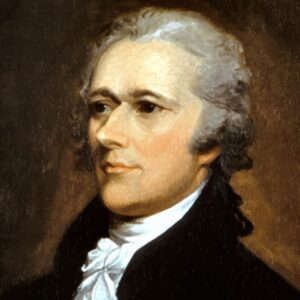
Alexander Hamilton, a former Delegate to the Constitutional Convention, from New York, using the pseudonym “Publius,” publishes “Federalist #68,” explaining the necessity for the Electoral College. In paragraphs one, three and five he writes:
THE mode of appointment of the Chief Magistrate of the United States is almost the only part of the system, of any consequence, which has escaped without severe censure, or which has received the slightest mark of approbation from its opponents. …
· · · · · · ·
A small number of persons, selected by their fellow-citizens from the general mass, will be most likely to possess the information and discernment requisite to such complicated investigations.
· · · · · · ·
Nothing was more to be desired than that every practicable obstacle should be opposed to cabal, intrigue, and corruption. … They have not made the appointment of the President to depend on any preexisting bodies of men, who might be tampered with beforehand to prostitute their votes; but they have referred it in the first instance to an immediate act of the people of America, to be exerted in the choice of persons for the temporary and sole purpose of making the appointment. …
Alexander Hamilton [Publius], “The Electoral College Will Prevent Cabal, Intrigue and Corruption in Presidential Elections,” from The Debate on the Constitution, two volumes, Bernard Bailyn, ed., (New York: Library of America, 1992), 2:333-37.