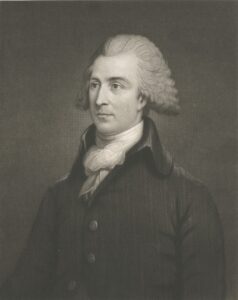

Delegate Tench Coxe, of the Commonwealth of Pennsylvania, using the pseudonym “A Freeman” writes a pro-federalist essay describing 14 powers that the proposed Constitution reserves to the States: .
- “[E]ach [S]tate can appoint every officer of its own militia, and can train the same, by which it will be sure of a powerful military support attached to, and even part of itself, wherein no citizen of any other [S]tate can be a private centinel, much less have influence or command.
- “Every regulation relating to religion, or the property of religious bodies, must be made by the [S]tate governments, since no powers affecting those points are contained in the constitution.
- “The [S]tate legislatures and constitutions must determine the qualifications of the electors for both branches of the federal government; and here let us remember to adhere firmly within our respective commonwealths to genuine republican principles. Wisdom, on this point which lies entirely in our hands, will pervade the whole system, and will be a never failing antidote to aristocracy, oligarchy and monarchy.
- “Regulating the law of descents, and forbidding the entail of landed e[S]tates, are exclusively in the power of the [S]tate legislatures. A perfect equality, at least among the males, and possibly among the females, should be established, not only in the strict line of descent, but in the most remote collateral branches. If a man omits to make a will, the public should distribute his property equally among those who have equal pretensions, and who are able to render equal services to the community. By these means, poverty and extreme riches would be avoided, and a republican spirit would be given to our laws, not only without a violation of private rights, but consistently with the principles of justice and sound policy. This power with that mentioned under the last head, if exercised with wisdom and virtue, will preserve the freedom of the [S]tates beyond any other means.
- “The elections of the President, Vice President, Senators and Representatives, are exclusively in the hands of the [S]tates, even as to filling vacancies. The smallest interference of Congress is not permitted, either in prescribing the qualifications of electors, or in determining what persons may or may not be elected.
- “The [S]tates elect, appoint and commission all their own officers, without any possible interference of the federal government.
- “The [S]tates can alter and amend their several constitutions, provided they do not make them aristocratical, oligarchic or monarchical–for the federal constitution restrains them from any alterations that are not really republican. That is, the sovereignty of the people is never to be infringed or destroyed.
- “The [S]tates have the power to erect corporations for literary, religious, commercial, or other purposes, which the federal government cannot prevent.
- “Every [S]tate can always give its dissent to federal bills, as each has a vote in the Senate secured by the constitution. Hence it appears, that the [S]tate governments are not only intended to remain in force within their respective jurisdictions, but they are always to be known to, and have their voices, as [S]tates, in the federal councils.
- “The [S]tates not only elect all their own officers, but they have a check, by their delegates to the Senate, on the appointment of all federal officers.
- “The [S]tates are to hold separate territorial rights, and the domestic jurisdiction thereof, exclusively of any interference of the federal government.
- “The [S]tates will regulate and administer the criminal law, exclusively of Congress, so far as it regards mala in se, or real crimes; such as murder, robbery, &c. They will also have a certain and large part of the jurisdiction, with respect to mala prohibita, or matters which are forbidden from political considerations, though not in themselves immoral; such as unlicenced public houses, nuisances, and many other things of the like nature.
- “The [S]tates are to determine all the innumerable disputes about property lying within their respective territories between their own citizens, such as titles and boundaries of lands, debts by assumption, note, bond, or account, mercantile contracts, &c. none of which can ever be cognizable by any department of the federal government.
- “The several [S]tates can create corporations civil and religious; prohibit or impose duties on the importation of slaves into their own ports; establish seminaries of learning; erect boroughs, cities and counties; promote and establish manufactures; licence taverns; alter the criminal law; constitute new courts and offices; establish ferries; erect public buildings; sell, lease and appropriate the proceeds and rents of their lands, and of every other species of [S]tate property; establish poor houses, hospitals, and houses of employment; regulate the police; and many other things of the utmost importance to the happiness of their respective citizens. In short, besides the particulars enumerated, every thing of a domestic nature must or can be done by them.”
Coxe goes on to emphasize the importance of State suffrage in the Senate: “ The senate will be representatives of the several [S]tate sovereignties. Every [S]tate must send its own citizens to the senate and to the house of representatives. No man can go thither, but from the [S]tate of which he is a complete citizen, and to which, if they choose, he shall be sworn to be faithful. No [S]tate shall on any pretence be without an equal voice in the senate.”
[added 7/25/2026]
Subsequent Events:
Authority:
Articles of Confederation, Article XIII
ccc-2point0.com/Articles-of-Confederation
References:
Michael Maharrey, with Michael Boldin, The Other Federalist Papers: Tench Coxe, (Irvine, California: By the author, 16755 Von Karman #200 PMB705, 2024), 61-68.