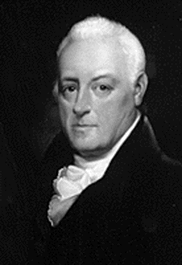
Robert Yates(?), a non-signing Delegate to the Constitutional Convention from New York, using the pseudonym “Brutus,” publishes an anti-federalist essay, arguing that the proposed Constitution for the united States lacks a “Declaration of Rights,” and should have one before ratification. In paragraphs three and six he writes,
The constitution proposed to your acceptance, is designed not for yourselves alone, but for generations yet unborn. The principles, therefore, upon which the social compact is founded, ought to have been clearly and precisely stated, and the most express and full declaration of rights to have been made—But on this subject there is almost an entire silence.
· · · · · ·
For the security of life, in criminal prosecutions, the bills of rights of most of the states have declared, that no man shall be held to answer for a crime until he is made fully acquainted with the charge brought against him; he shall not be compelled to accuse, or furnish evidence against himself— The witnesses against him shall be brought face to face, and he shall be fully heard by himself or counsel. That it is essential to the security of life and liberty, that trial of facts be in the vicinity where they happen. Are not provisions of this kind as necessary in the general government, as in that of a particular state? The powers vested in the new Congress extend in many cases to life; they are authorised to provide for the punishment of a variety of capital crimes, and no restraint is laid upon them in its exercise, save only, that “the trial of all crimes, except in cases of impeachment, shall be by jury; and such trial shall be in the state where the said crimes shall have been committed.” No man is secure of a trial in the county where he is charged to have committed a crime; he may be brought from Niagara to New-York, or carried from Kentucky to Richmond for trial for an offence, supposed to be committed. …
NOTE: Although the identity of “Brutus” is not known for sure, many scholars believe him to have been Robert Yates, an Associate Justice of the New York Supreme Court.
[restored 9/27/2021]
Former Delegate Arthur Lee, to the united States in Congress assembled, using the pseudonym “Cincinnatus” publishes an anti-federalist essay attacking the pro-ratification speech of James Wilson. In paragraphs 1, 4, 5, 6, 7 and 8 he warns:
… [S]ome material parts of the proposed Constitution are so constructed–that a monstrous aristocracy springing from it, must necessarily swallow up the democratic rights of the union, and sacrifice the liberties of the people to the power and domination of a few.
· · · · · · ·
The confederation, in its very outset, declares–that what is not expressly given, is reserved. This constitution makes no such reservation.
… [T]he president and senate are empowered to make treaties, and these treaties are declared the supreme law of the land.
What use they will make of this power, is not now the question. Certain it is, that such power is given, and that power is not restrained by any declaration–that the liberty of the press, which even you term, the sacred palladium of national freedom, shall be forever free and inviolable. …
Let us suppose then, that what has happened, may happen again: That a patriotic printer, like Peter Zenger, should incur the resentment of our new rulers, by publishing to the world, transactions which they wish to conceal. If he should be prosecuted, if his judges should be as desirous of punishing him, at all events, as the judges were to punish Peter Zenger, what would his innocence or his virtue avail him? This constitution is so admirably framed for tyranny, that, by clear construction, the judges might put the verdict of a jury out of the question. Among the cases in which the court is to have appellate jurisdiction, are –controversies, to which the United States are a party:–In this appellate jurisdiction, the judges are to determine, both law and fact. That is, the court is both judge and jury. The attorney general then would have only to move a question of law in the court below, to ground an appeal to the supreme judicature, and the printer would be delivered up to the mercy of his judges. Peter Zenger’s case will teach us, what mercy he might expect. Thus, if the president, vice-president, or any officer, or favorite of state, should be censured in print, he might effectually deprive the printer, or author, of his trial by jury, and subject him to something, that will probably very much resemble the–Star Chamber of former times. The freedom of the press, the sacred palladium of public liberty, would be pulled down;–all useful knowledge on the conduct of government would be withheld from the people–the press would become subservient to the purposes of bad and arbitrary rulers, and imposition, not information, would be its object.
… [I]t was the jury only, that saved Zenger, it was a jury only, that saved [Henry Sampson] Woodfall, it can only be a jury that will save any future printer from the fangs of power. [emphasis in the original]
[restored 7/18/2026]
Subsequent Events:
References:
“Reply to Wilson’s Speech ‘Cincinnatus,’” from The Debate on the Constitution, two volumes, Bernard Bailyn, ed., (New York: Library of America, 1992), 1:92-96.
Murray Dry, The Anti-Federalist: An abridgement, from The Complete Anti-Federalist by Herbert J. Storing, ed., (Chicago and London: University of Chicago Press, 1985), 117, 119, 121.
Brutus II
www.infoplease.com/primary-sources/government/anti-federalist-papers/brutus-ii
The Prophetic Antifederalists | Mises Institute
mises.org/library/prophetic-antifederalists